Luckily, two of S+F’s inner circle of food aficionados have taken over for the week, because you, dear reader, have been deprived since Spoon’s last post about those decadent hazelnut and chocolate buns. Enter your guest bloggers: Fillet Knife and Butcher Twine. Yes, two very underrated kitchen utensils, ones that you may own, but that are probably relegated to that lower utensil drawer amongst the Krustbuster and Bacon Genie. Yet, when it comes to the highfalutin chops of one Julia Child, these two tools should be deemed indispensable.
A little background info so you know we’re legit:
Fillet Knife and Butcher Twine (FK and BT) grew up down the block from each other. They were in the same class from kindergarten through high school, were known throughout Northeastern New Jersey for their tennis court managerial skills, and even battled each other in the annual Gingerbread Throwdown Invitational, in which BT once made a highly impressive gingerbread Parthenon and FK (along with Spoon) showed off a stirring rendition of a gingerbread tiki hut. But we digress...
One night over Checker Cabs at the neighborhood fave Almond, FK and BT discussed the recent Julie and Julia film starring Meryl Streep and Amy Adams.
“I mean, did you see that duck? That thing was crazy. Stuffed with all that….stuff….and then wrapped in dough?,” pondered FK.
“I don’t think it’s that hard,” commented BT, “I mean, I bet we could do it”.
Keep in mind neither of us owns Mastering the Art of French Cooking (for shame!), nor has either ever attempted such a feat. We’re fans of simpler, dare we say, healthier alternatives. Never ones to turn down a challenge, however, we hatched our plan.
Pâté de Canard en Croûte, is what you’d call Duck, Stuffed with Pork, Veal, Pork Fat and Then Wrapped Up in Pastry Dough in the vernacular. (Sounds prettier – and less caloric - in French, doesn’t it?)
We won’t bore you with the details, but here’s the basic synopsis of how this all went down.
1. BT expertly put together the dough ahead of time. While doing so, BT realized two things. First, Julia Child’s cookbook predates the days of Kitchen Aid mixers. And second, that Julia seemingly forgot to say when to put the eggs in the recipe. Luckily, BT inherited his mother’s baking / pastry skills and was able to correctly guess when they needed to be added to the dough.
2. FK assembled the stuffing – veal/pork/salt pork (cured pork fat), eggs, spices, and a marsala/port reduction with butter and chopped onion. (cue the music).

The reduction made FK smile and think of one of Julia’s best-known lines, “I love cooking with wine—sometimes I even put it in the food.”
 These two steps, if ever you decide to make this dish, are best done ahead of time. Consider them your mise en place. That way, you'll feel like a Top Chef, and Tom Colicchio can tell you that your flavor profiles are spot on, you'll win a billion dollars and enough Glad plastic wrap to last you a lifetime. Since this recipe takes up a good five or six pages in the original Mastering… know that it’s a long process, and might take 4-5 hours in all.
FK and BT got together on a rainy Saturday night with the recipe, tools, and ingredients necessary. They brought their A game. Parched before they even began, BT poured a few glasses of wine.
The first step of this recipe has you bone the duck. We took Donald (a 5-pounder from the renowned Otomanelli Brothers) out of his packaging (note the funny “I’m gonna carve myself up now!” logo below)

...and began the dissection dismemberment butchering.


Using a very sharp fillet knife, FK and BT skillfully carved down the backbone and along the rib cage, marveling at how easily the breast meat fell away from the bone. And heavens, what fat! Those ducks obviously haven't heard of heart-healthy eating.
Navigating our way through the wing and thigh joints, however, was a bit tricky. “When you come to the ball joints connecting the wings and the second joints to the carcass, sever them,” says Julia.

But on which side? Perplexed, we decided to wing it (pun intended), and using some nifty kitchen shears, cut the joints down the middle.
Pretty confident and proud of ourselves, we scanned over the recipe and chuckled at our favorite line of the night, “By the time you have completed half of this, the carcass frame, dangling legs, wings and skin will appear to be an unrecognizable mass of confusion and you will wonder how in the world any sense can be made of it all.”

Oh Julia, you have such a way with words.
The following conversation ensued:
BT: This whole butchering thing isn’t all that hard.
FK: (carving here, trimming there) Top off that wine glass and let’s figure out how to take the cavity out of the bird. Eww, this is so gross.
BT: I think we need to be extra careful when cutting between the skin and the breastbone. Julia says the skin is very thin and can be easily slit.
FK: I’m sure we can figure it…oh…yeah…I see…she’s right. Hmm. I don’t really know how we can cut it out without cutting some of the skin.
BT: Well, I think we already botched it when we cut a few holes in the skin to remove the wings, so we’ll just wrap it in extra twine.
Relieved, duck cavity removed (along with the bag of undesirable organ meats, the neck, and God knows what else…), we threw it in a bowl and set it aside (looks scrumptious, doesn’t it?!)

FK brought out the stuffing and BT took over, chopping up some of the breast meat we had removed, and mixed it with yet more marsala, port, salt, pepper, etc. (We think at this point, you could veer from the original recipe and add any type of herbs you like, chopped mushrooms, perhaps, even some toasted breadcrumbs if you wanted to make it less dense).
We amassed the, um, mass, and molded it into a meatloaf-shaped pile inside the duck. So far, so good. Protein inside protein inside pastry. What could go wrong?
Here is the point at which we realized a few important details:
a) our duck was bigger than the one in the recipe, thus making it heavier, and all around bulkier (balkier? No, bulkier).
b) we had a few unfortunate holes, which allowed the stuffing to kinda peek out.
But we're quick. We know the drill, so we wrapped the heck out of our duck with a lot of twine, and instead of browning it in a frying pan (maybe a paella pan would've worked, but alas, we were without one), we put it on a baking sheet and stuck it under the broiler for a few minutes, getting a little crispiness to appear on each side.


Once out of the oven, we let it cool, and BT rolled out 2/3 of the chilled dough, which we then wrapped around the bottom portion of the duck. It came up pretty far, and kinda looked like a papoose (not to be confused with capital P Papoose).

The top third was rolled out and put on top.
At this point, we were tired, but having a good time. Julia, always the consummate connoisseur of the kitchen, suggested we use the leftover dough to cut out some pretty flowers. The explanation and accompanying pictures took up almost an entire page. We decided instead to adorn our pièce de résistance with our real life initials.
The masterpiece went into the oven on a rack over a pan (enough fat oozed out to fill 1/2 coffee can. Nice!) for about 2 1/2 hours. We let the meat cool for over an hour (during which time, steam poured out of the steam hole we had put on top of the duck (per Julia) at a ferocious speed.)

Thankfully, one very kind soul joined us for a taste. And guess what! It wasn't all that bad. It reminded FK of a very meaty, sumptuous calzone. BT thought it was similar to a fancy meatloaf wrapped in pastry dough (and since BT is a meatloaf fan, that is a compliment). The dough was crunchy on the outside, (shiny from an egg wash) hiding moist stuffing inside.
The real gem, though, was the back of the duck, the tender pieces of thigh that were hidden under layers of flaky pastry, surrounded by the stuffing.
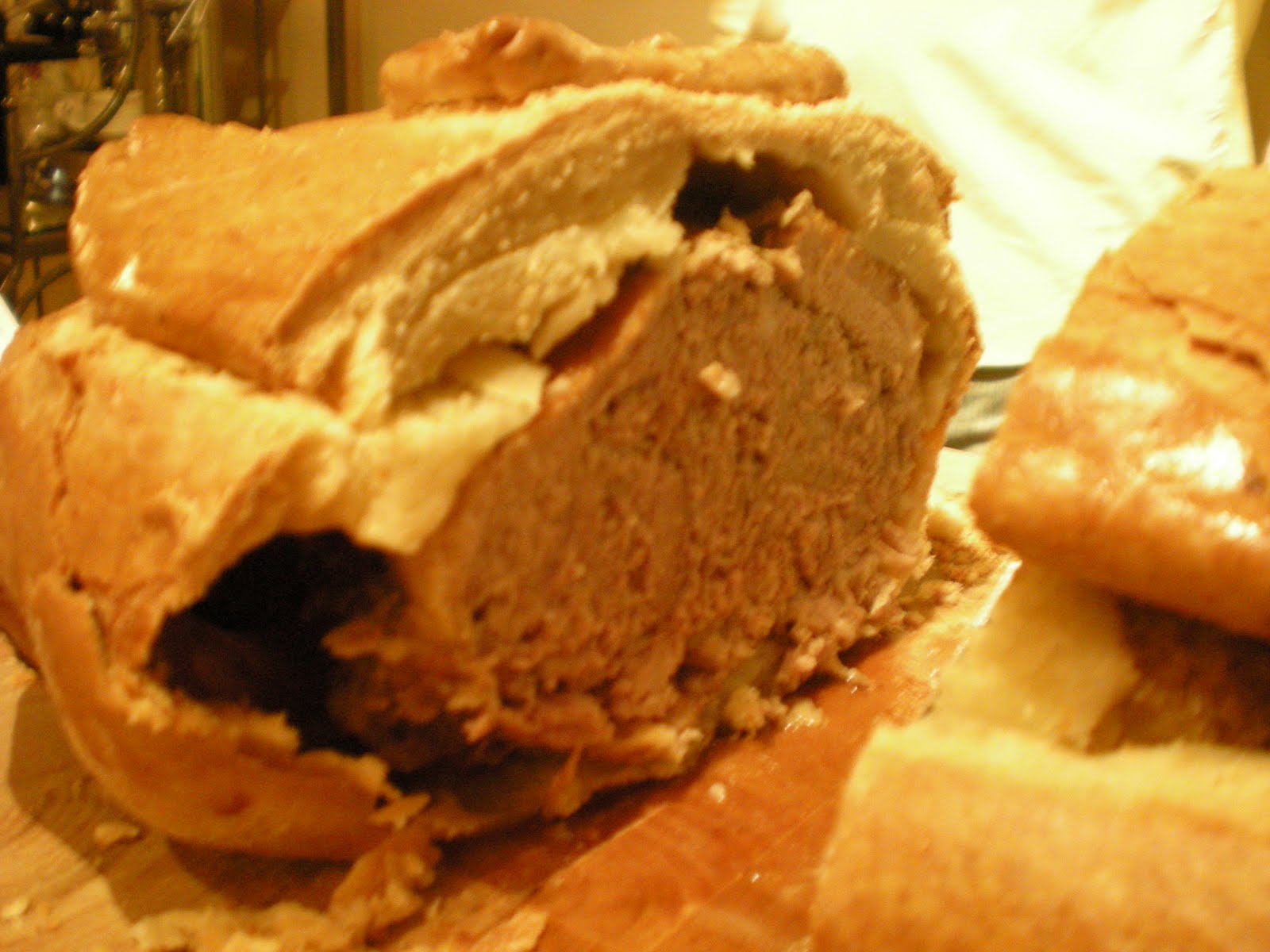
Would you whip this up on a Tuesday night? Probably not. Was it worth the 4+ hours of work? Possibly.

Did it inspire us to try a turducken? Oh yes. But it's definitely tastier than its Tex-Mex successors, the Cheesy Gordita Crunch Supreme or whatever it is they serve over at Taco Town these days.


